
By Jonathan L. Larson, Entomology Extension Specialist
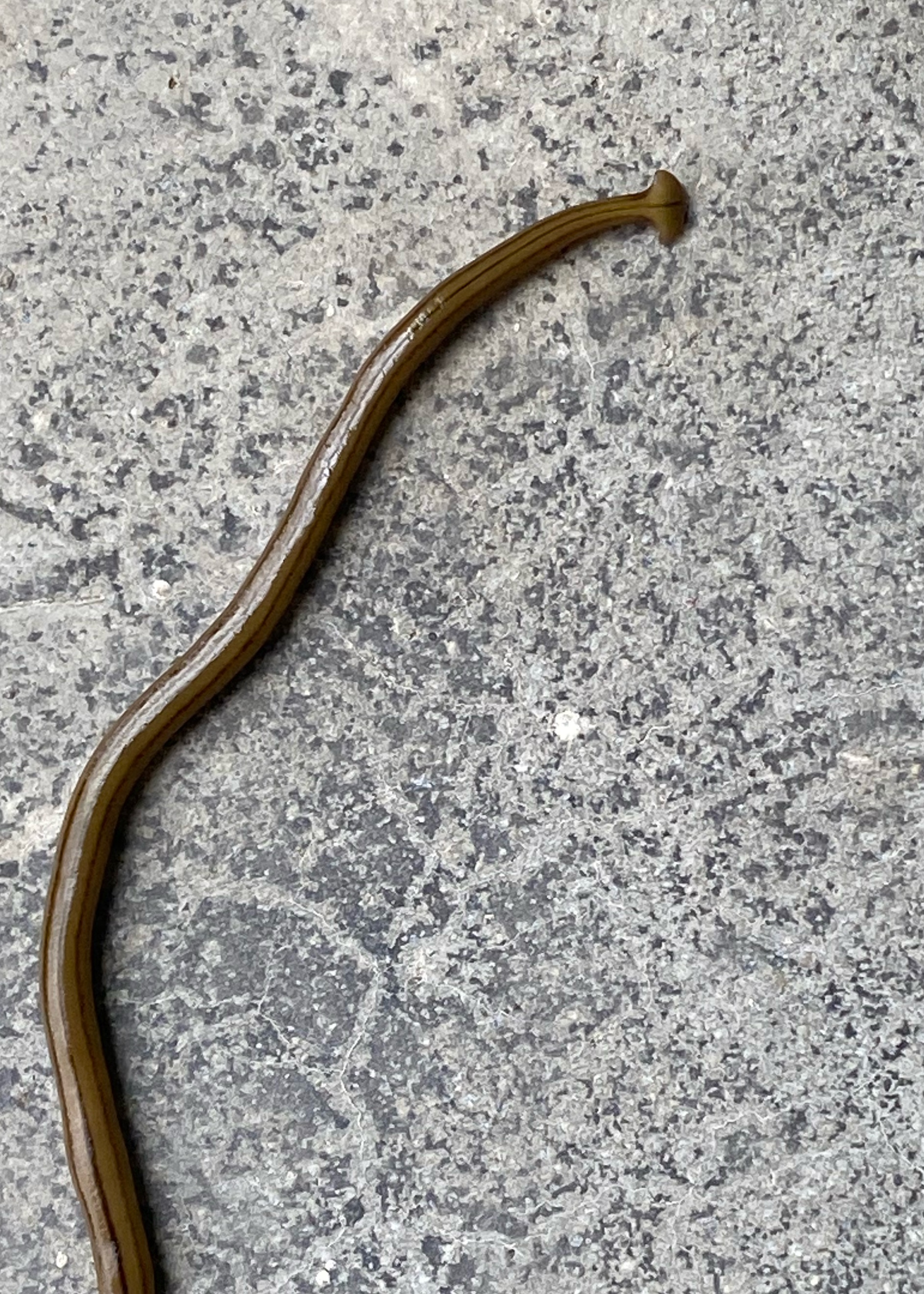
Over the last 2 years, the Extension entomology group has received multiple inquiries about strange, ribbon-like worms with hammer or moon-shaped heads. These are creatively named “hammerhead worms,” and they are predaceous flatworms that look like something made up for Star Wars. There have also been some social media posts that promote fear about hammerhead worms. These slimy weirdos are in Kentucky, but luckily, they don’t pose a huge risk to humans and there are some options if one is discovered on your property.
Identification
Hammerhead worms are land planarians, a group of flatworms. Flatworms differ from the earthworms most Kentuckians are familiar with in that they are flat and unsegmented. Earthworms on the other hand have segmented bodies; the bands that can be seen on them mark the segments.
Hammerhead worms are of a similar hue to earthworms, typically light brown or honey in color. Some of the species seen in Kentucky have varying numbers of dark stripes that run down their back. For example, Bipalium kewense (also known just as hammerhead flatworm) has five dark lines, while Bipalium pennsylvanicum or the three-lined flatworm has… three lines.

Hammerhead worms can be impressively long; some can be over 10 inches long. Aside from their size, the other thing most people notice is their weirdly shaped hammer or half-moon shaped head that gives the group their name.
What is the Issue?
The two flatworms listed above are potentially invasive and definitely non-native organisms, which can have effects on Kentucky ecosystems. There are flatworms native to Kentucky; they have unfortunately been lumped in with the invaders as “bad”.
One of the potential problems with hammerhead worms is their diet. They are predaceous, feeding on snails, slugs, and earthworms. Earthworms are broadly considered beneficial organisms and so there is worry that if hammerhead worms were to fully “invade” that they may harm populations of nightcrawlers and other earthworms that provide ecosystem services by decomposing various materials in nature.
Finally, hammerhead worms do pose a slight medical and veterinary concern. Some species produce tetrodotoxins, which are potent and most famously associated with pufferfish. That being said, encountering or even accidentally making skin-to-worm contact won’t automatically kill you. Being aware of what these flatworms are and exercising caution around them is recommended. People should avoid handling or holding hammerhead worms. If you touch any, wash your hands afterwards. Hammerhead worms are also potential hosts for rat lungworms, as are snails and slugs. Humans can acquire this parasite by consuming undercooked or raw snails, slugs, freshwater shrimp, crabs, and frogs. Because of the toxin and possible parasites, if you were considering it, definitely do not eat hammerhead worms!
Are they in Kentucky?
The short answer is yes, these have been found in the state. Between 2020 and 2023, samples were confirmed from Letcher, Calloway, Pulaski, Fayette, Marshall, Boyd, Casey, and Whitley Counties. In 2024, images and samples have been brought in from Allen, Jefferson, and Russel Counties as well.

This suggests a possibly wide distribution in the state. While hammerhead worms aren’t “actionable pests,” (as in they don’t have government actions associated with them), Kentuckians can help us keep track of these worms if they would like to e-mail photos and a location. Hammerhead worms are most likely to be found in warm, damp environments. They might be spotted under rocks and logs or in leaf litter. Sightings of hammerhead worms may increase on rainy days, particularly if the rainy day occurs after a dry period.
Management

There isn’t a true management tactic for these. No sprays or baits can be applied to prevent or control them. There are some things that can be done to kill an individual worm that is discovered.
First, don’t try to physically destroy or cut up the worms. Segmenting them can result in reproduction. Part of their body does naturally “fall off” and turn into a new individual, so don’t help them with that process. Salting them, like you would a snail or slug, will destroy them. Do be cautious about not getting salt in the soil around your plants. Spritzing the hammerhead worm with vinegar or citrus oil can also kill it. If you need to isolate the treatment, you can pick up the hammerhead worm with tweezers or gloved hands, and put it in a sealable bag; then apply salt or vinegar.

Leave a Reply